
Benchmark on Linux
The same contenders and scenarios as in Benchmark, on a Linux server with a 15 W laptop processor: every proxy gets 2 cores.
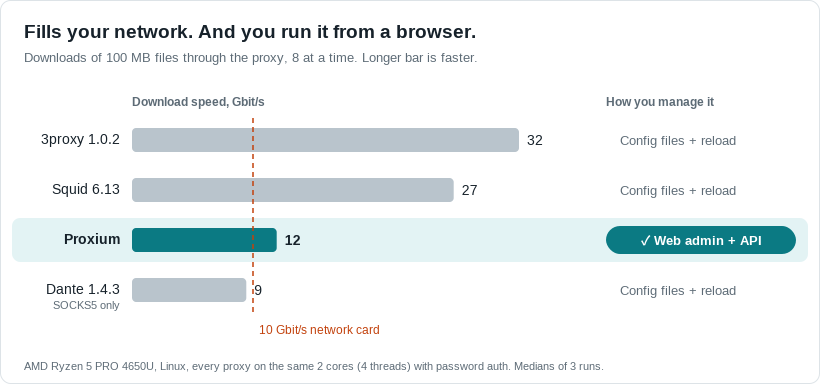
- Fills a 10 Gbit/s link on 2 laptop cores: 12 Gbit/s. Dante stays below the link at 9.5.
- On a par with Dante on SOCKS5: about 2,900 new connections a second against 3,000–3,500.
- Half the memory of Squid: about 400 MiB against 800.
- Steady under load: the same 2,950 new tunnels a second from 50 to 500 clients at once, and the same within a few percent from run to run.
- More than enough, and it scales. One worker per core, more servers on one database: connection limits, speed limits and quotas hold across all of them, every instance shows in the admin UI.
- The only one managed in a browser. Accounts, policies, outgoing IPs and traffic live in a web admin UI and a REST API. The others are configured in files and reloaded.
Results
Section titled “Results”Every request opens a new connection to the proxy, so every result includes authentication. No errors in any run.
With 32 downloads at a time instead of 8 the picture holds: Proxium 11.5 Gbit/s over CONNECT and 11.3 over SOCKS5.
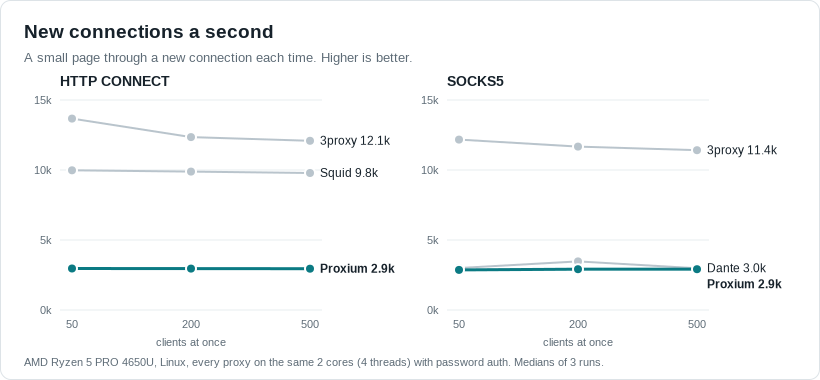
On plain HTTP with 200 clients: Proxium 2.4k, Squid 10.9k, 3proxy 13.0k. Squid keeps connections to the target open between plain HTTP requests, Proxium opens a new one for each.
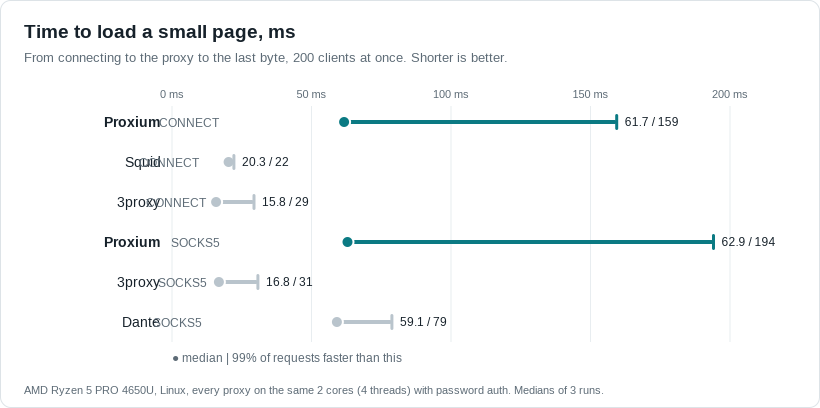
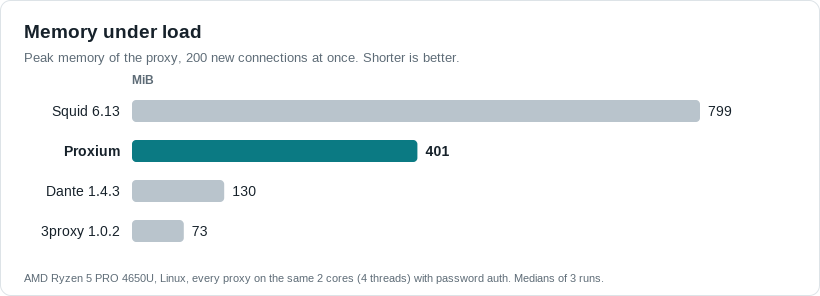
Proxium’s memory stays flat under load: 409 MiB at 500 clients, 530 MiB with 32 downloads at a time.
How it was measured
Section titled “How it was measured”- Host: AMD Ryzen 5 PRO 4650U, 6 cores, 12 threads, 15 W, up to 4 GHz. Debian 13 in an LXC container, Docker 29.9.
- Cores: every proxy pinned to the same 2 cores (4 threads), the load generator to 3 others, the target and Proxium’s database and Redis to the last one.
- Runs: every scenario 3 times, each round starting from a different contender. The charts show medians.
The contenders, the load, the fairness notes and the configs are the same as in Benchmark.