
Benchmark
Proxium against Squid, 3proxy and Dante on the same 4 cores, each set up as a production forward proxy with password authentication.
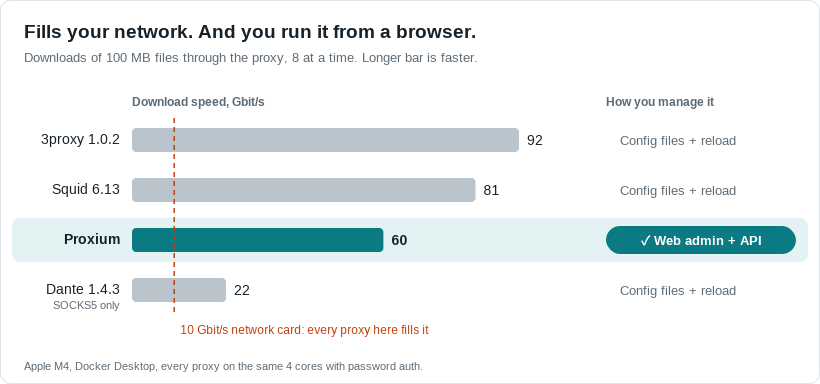
- Downloads hit the network first. Proxium pushes about 60 Gbit/s through 4 cores, six times what a 10 Gbit/s network card carries. On a real server the link runs out long before the proxy does.
- 16,000 new tunnels a second on 4 cores, over a billion a day, and more as the load grows: 14.2k at 50 clients at once, 16.7k at 500.
- Ahead of Dante on SOCKS5: 1.7 times the connections, 2.4 times the download speed.
- Half the memory of Squid: about 410 MiB against 810.
- More than enough, and it scales. One worker per core, more servers on one database: connection limits, speed limits and quotas hold across all of them, every instance shows in the admin UI.
- The only one managed in a browser. Accounts, policies, outgoing IPs and traffic live in a web admin UI and a REST API. The others are configured in files and reloaded.
Also measured on a Linux server with a 15 W laptop processor: Benchmark on Linux.
Results
Section titled “Results”Every request opens a new connection to the proxy, so every result includes authentication. No errors in any run.
With 32 downloads at a time instead of 8 the picture holds: Proxium 63 Gbit/s over CONNECT and 54 over SOCKS5.
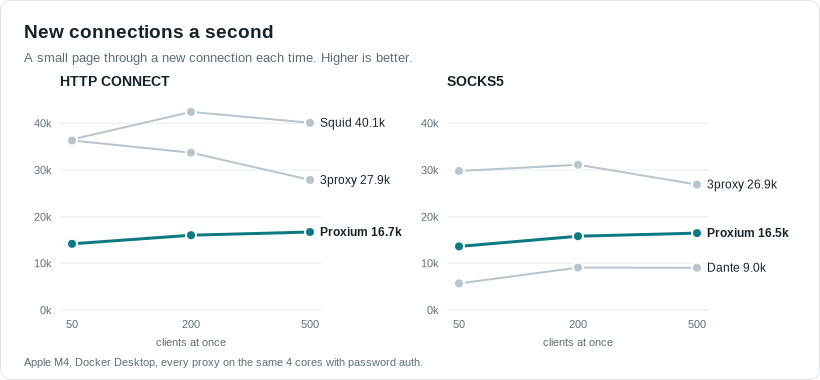
Proxium gains as clients pile up, 3proxy loses a quarter. On plain HTTP with 200 clients: Proxium 12.9k, 3proxy 31.2k, Squid 51.7k. Squid keeps connections to the target open between plain HTTP requests, Proxium opens a new one for each.
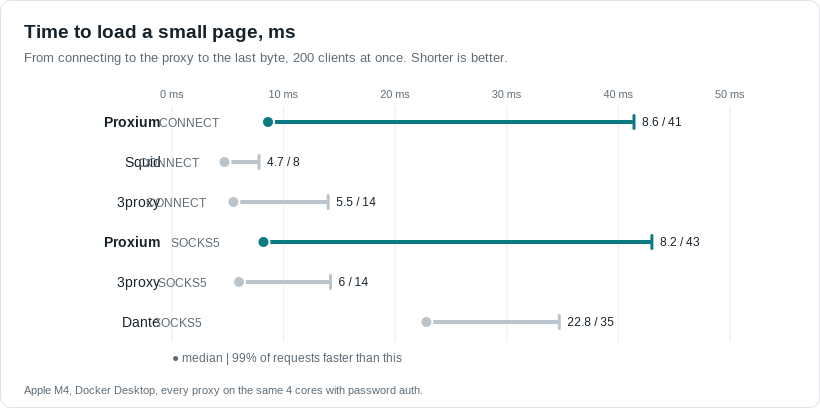
A target on the internet answers in 20–200 ms, the proxy adds a few of them.
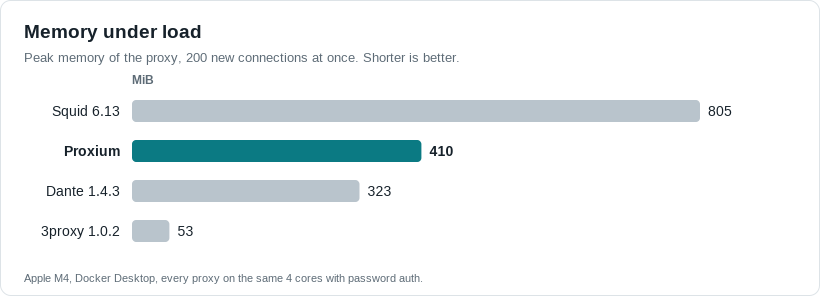
Proxium’s memory stays flat under load: 416 MiB at 500 clients, 440 MiB with 32 downloads at a time.
How it was measured
Section titled “How it was measured”- Host: Apple M4, Docker Desktop 29.9 on macOS. The numbers compare the proxies with each other; a Linux server with dedicated cores gives other absolute values.
- Cores: every proxy pinned to the same 4 cores, the load generator to 5 others, the target and Proxium’s database and Redis to one more.
- Contenders: Squid 6.13 (Canonical’s image), 3proxy 1.0.2 (the official image), Dante 1.4.3 (as packaged in Ubuntu 24.04, no official image). Proxium 0.4.0 with 4 workers.
- Target: nginx 1.27 serving a small page and a 100 MB file.
- Load: a generator in Go. A new connection to the proxy for every request,
Connection: close, 5 seconds of warmup, then 10 seconds for small pages and 20 seconds for downloads. - CPU and memory: read from the containers’ cgroups.
Fairness:
- Every proxy checks a username and password, logging is off or at errors only, Squid’s cache is off.
- Squid runs with 4 SMP workers. Its image starts it with
-N, which ignoresworkers, so it runs with--foregroundinstead. - Squid caches checked credentials for 10 seconds, like Proxium caches accounts.
- Dante checks the system password on every connection with no cache. The user’s password is hashed with MD5-crypt, like Squid’s: with Ubuntu’s default yescrypt Dante tops out at about 150 connections a second.
The configs of the contenders: Squid
with its password file,
3proxy,
Dante, the target
nginx. The test user is bench with the
password bench.